Pickleball Paddle Angle: Think Driver, 7-Iron, and Sand Wedge
Most players own one paddle angle. They find a face they like, and they use it from the baseline, from the transition zone, and at the kitchen line. Then they wonder why the same swing that feels great on a drive sails long on a dink.
In this lesson, PPR-certified instructor Jeff Gehm borrows an idea every golfer already understands: you do not swing one club for every shot, so stop using one paddle angle for every shot. Choose your paddle face the way you choose a club — by where you are standing and how far the ball has to travel.
The Club-Selection Rule
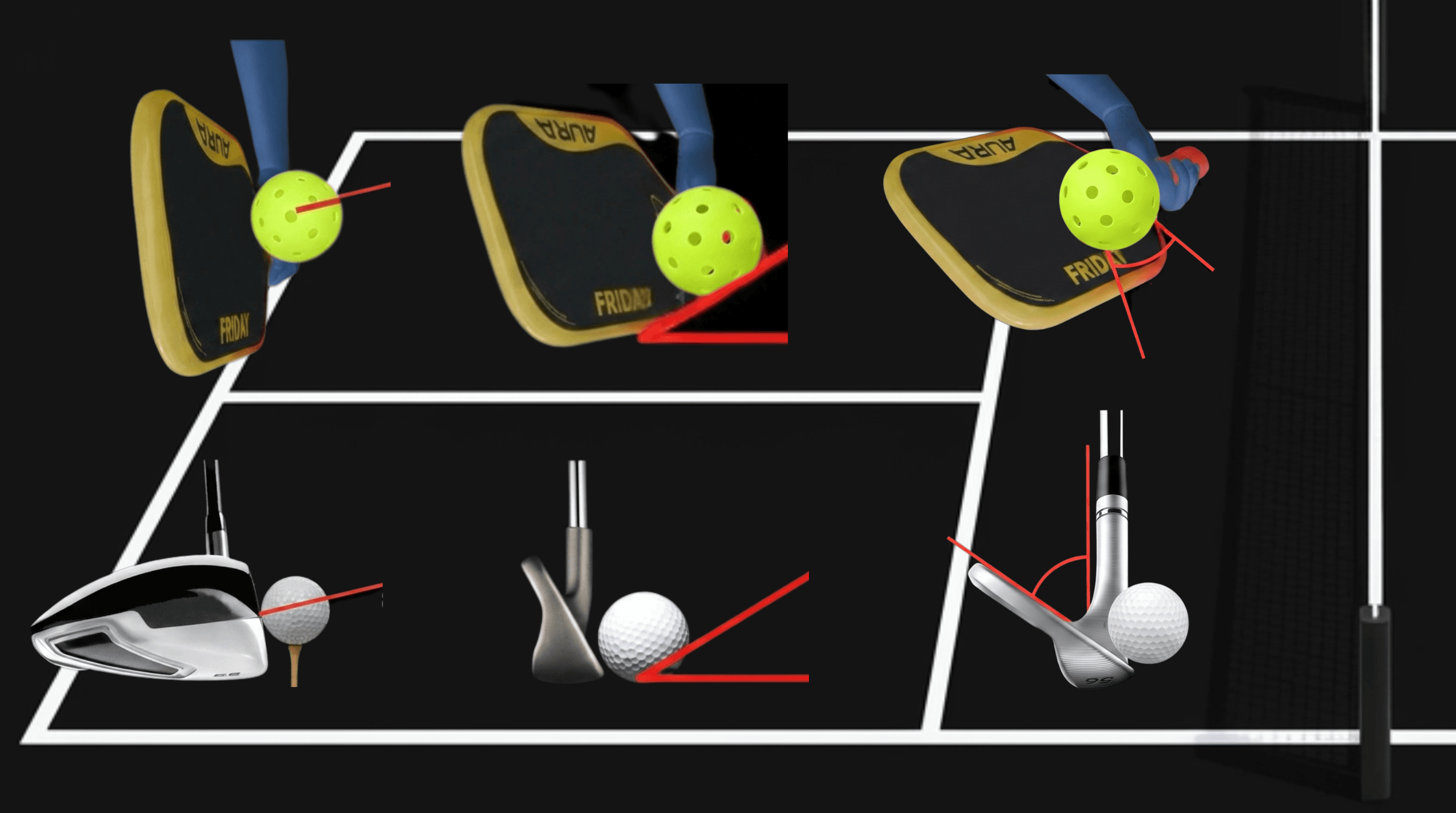
A golf club changes one thing more than any other: loft — how far the face leans back. Low loft sends the ball far and flat. High loft sends it high and short. A paddle face does exactly the same job, and your position on court tells you which loft you need.
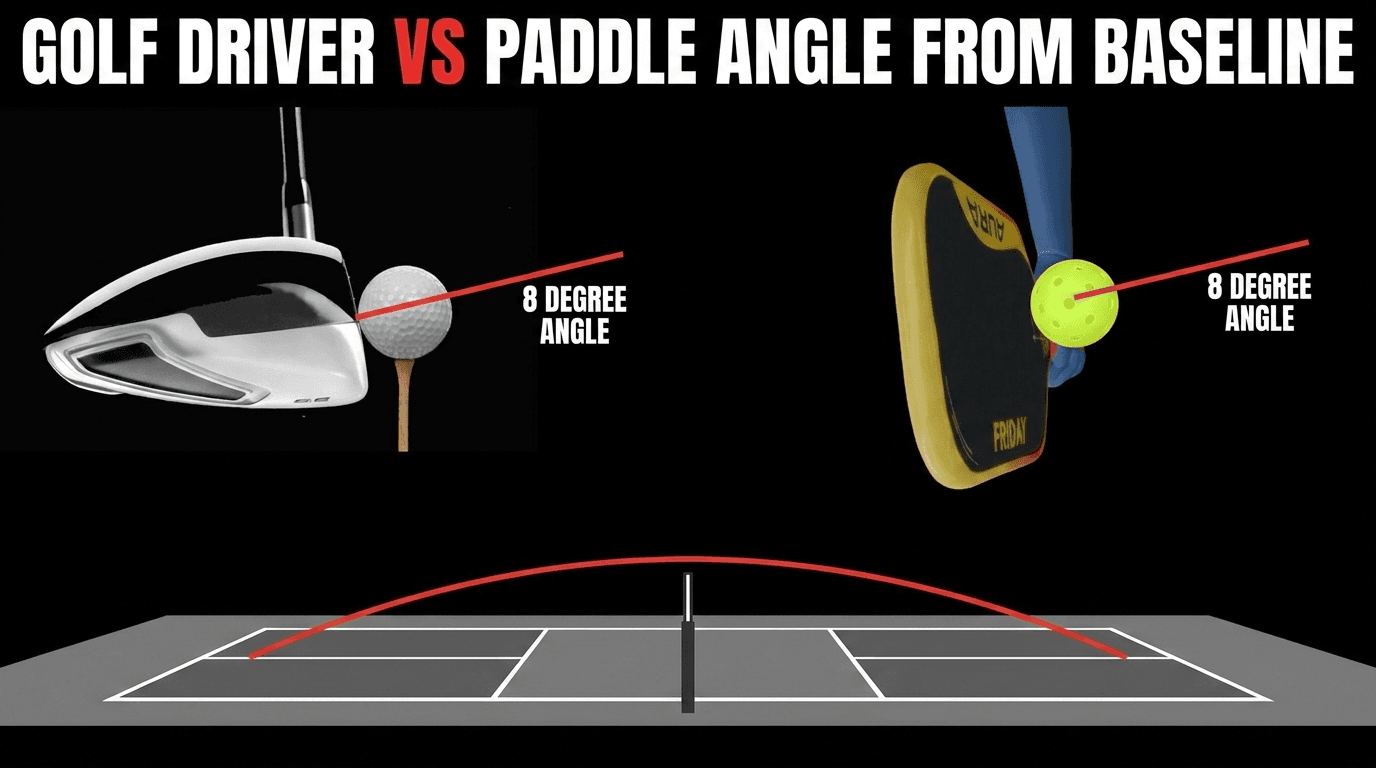
- Baseline → driver. Roughly 8 degrees. Flat face, hard and low.
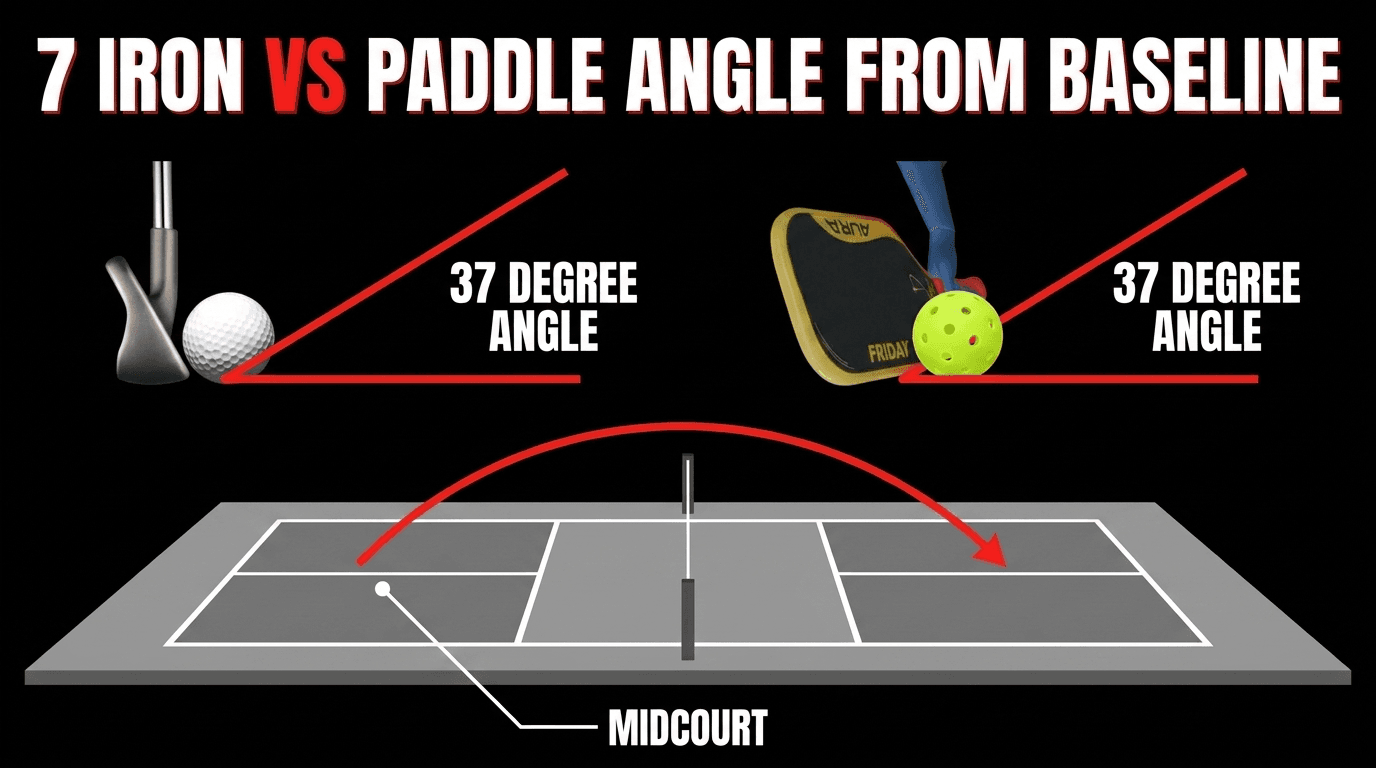
- Transition zone → 7-iron. Roughly 37 degrees. Higher, but shorter.
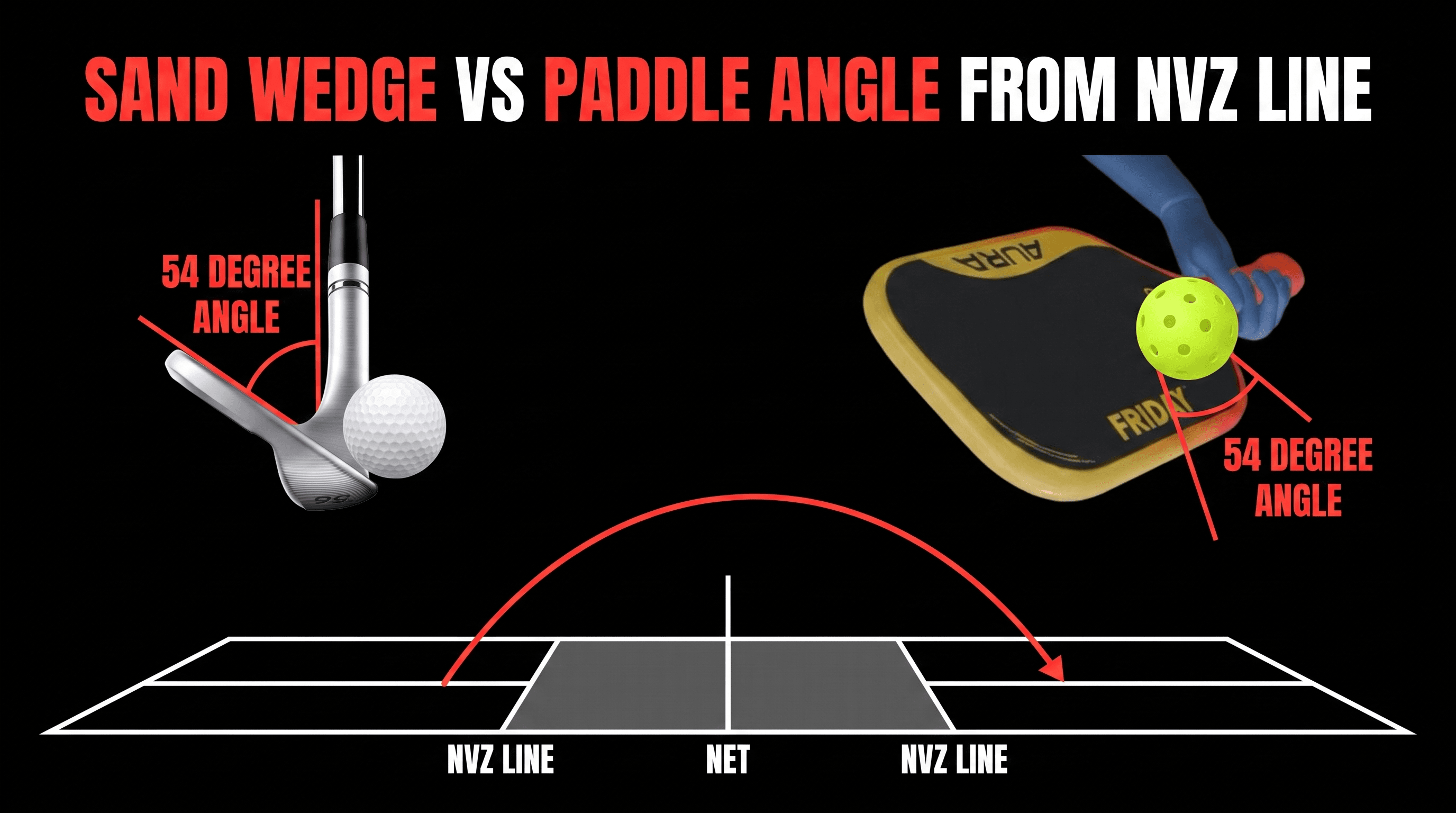
- Kitchen line → sand wedge. Roughly 54 degrees. Open face, high arc, soft landing.
Baseline: Think Driver
From the baseline the ball has the whole court to cover, so you want the flattest face you will use all match. Jeff sets his actual driver at about eight degrees, and that is the same shape he wants on a baseline drive: a low, penetrating ball that stays under your opponent's comfortable contact point.
Transition Zone: Think 7-Iron
Move up and the math changes. You have less court in front of you, so a flat face runs out of room. A 7-iron sits at about 37 to 38 degrees, and that extra loft is the point: the ball climbs higher and travels shorter. That is what lets you land a ball in the back court instead of driving it past the baseline.
Kitchen: Think Sand Wedge
At the non-volley zone you have almost no court to work with and a net directly in front of you. This is wedge territory — around 54 degrees. Open the face and let the ball climb over the net, then fall. Watch a good dink and you will see it: surprisingly high on the way up, remarkably soft on the way down. That combination is the whole goal.
Want the full lesson on video?
Jeff walks through all three angles at the driving range, then demonstrates the kitchen-line corrections live on court.
Watch on YouTubeThe Part Most Players Get Wrong
Here is the mistake Jeff sees most often from students. They pick a mid-loft face — call it a six iron — for the back of the court, and then they keep using that same six iron at the kitchen line. Two problems follow immediately: not enough loft to clear the net comfortably, and too much pace for the short distance.
It shows up as a paddle that dips. Instead of staying up and open, the paddle drops down, the knees stop working, and the only way left to get the ball over is to hit it harder. That is how a dink turns into a pop-up — or into the net.
If I hit the net, I am done.
Pace, Height, and Spin
Every dink is a decision between three things. Jeff's framing is that you are always spending from the same budget:
- Pace — how hard you hit it
- Height — how much you lift it
- Spin — how much you shape it
The catch is that distance decides how much of each you can afford. The shorter the shot, the less room you have — and short shots are exactly where most players overspend on pace.
Straight Ahead: Only 14 Feet
When you hit straight across, your opponent is about 14 feet away. Jeff demonstrates this on court with a golf ball retriever held up as a barrier — with the paddle low, you have to hit a genuinely high ball just to clear it. And once you commit to that height over that short a distance, everything else has to shrink:
- Lower your expectation on pace — it has to be a softer ball.
- Accept that there is not much time to work spin into it.
- Get the height and the pace right, because the net is unforgiving.
Why Cross-Court Is Better
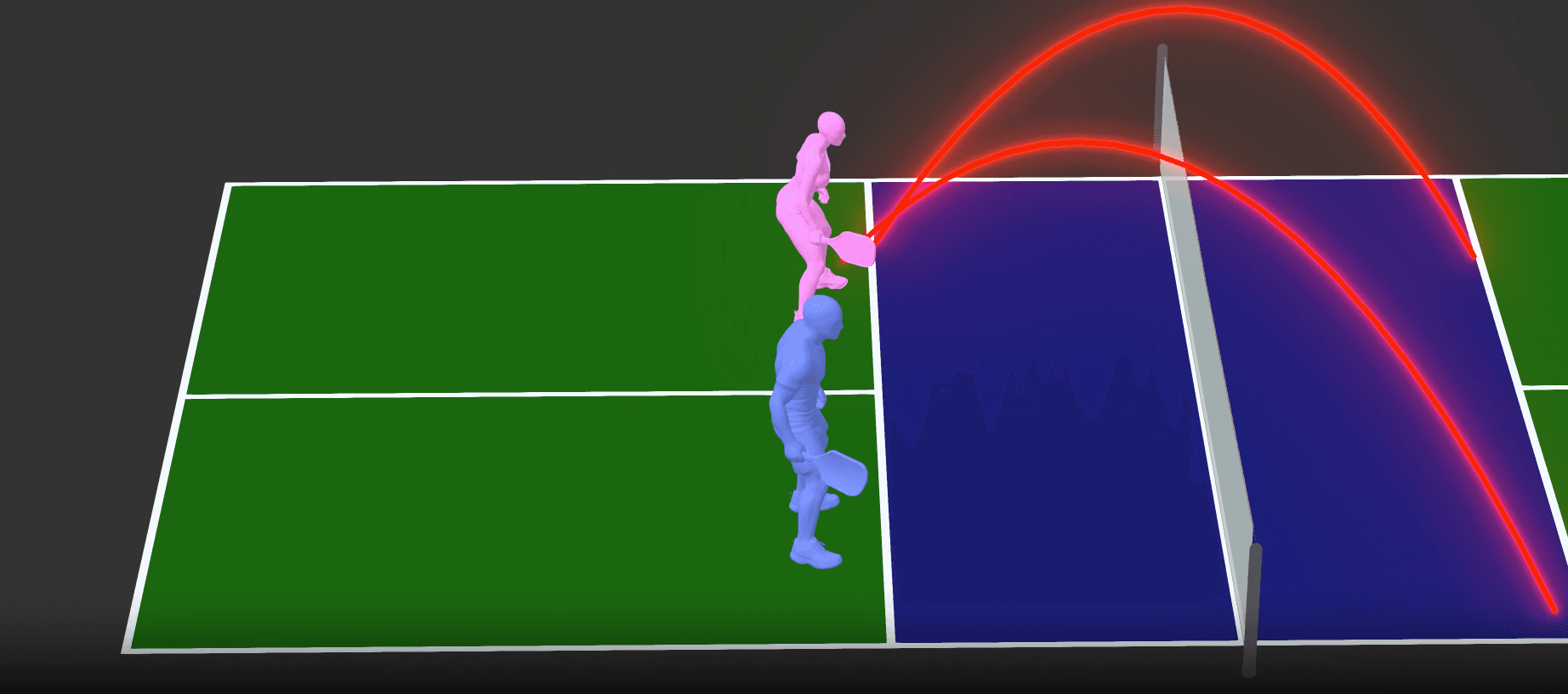
Now hit the same shot diagonally. The distance jumps from 14 feet to about 21 feet — and that changes your club selection. As Jeff puts it, you no longer need a sand wedge. A pitching wedge or a nine iron will do, because you have more distance to play with.
Less loft means you can set the paddle angle down a little, which frees up the rest of the budget:
- You can hit with more pace.
- You have room to add topspin or cut spin, whichever you want.
- You can drive it into the corner — and to a right-handed opponent, that lands on their backhand.
It also does something a straight dink cannot: it moves your opponent horizontally, which is how dinking creates openings in the first place.
Changing Your Angle at the Kitchen Line
None of this works if your body stays still. Jeff's point is that paddle angle and movement are the same skill: you have to change how you move at the non-volley zone, open the paddle and lift — or turn, take a little angle off, and push the ball straight across with a bit more pace. The angle you need depends on the shot you have chosen, and the footwork is what lets you get there in time.
Three Questions Before Every Dink
This is the whole lesson compressed into something you can actually run in real time. Before you hit, ask:
- How high do I have to hit it?
- How much pace do I have to put on it?
- How much room for spin do I have?
The answers come from where you are standing and where the ball is going. Fourteen feet straight ahead gives you one set of answers. Twenty-one feet cross-court gives you another. The paddle angle follows the answers, not the other way around.
You do not need to be a golfer for this to work. You just need to stop treating every shot the same. Match your paddle angle to your position on court, and the rest of the shot gets a lot easier to feel.
Which "club" have you been using at the kitchen? Let us know in the comments on the video.
More free coaching from Jeff
New pickleball lessons and paddle breakdowns every week on the Limitless Pickleball channel.
Subscribe on YouTube