Did the Six Zero Coral Pro Lose Its Spin After 176 Hours?
The short answer
A couple of months ago I reviewed the Six Zero Coral Pro and said the real test would be how the face held up over months, not weeks. That paddle now has about 176 hours on it. I play with it several times a week, and it has been my main paddle for four months.
So did it lose its spin? A little. Under the spin camera, my 4-month-old Coral Pro averaged 1,945 RPM on serves. A brand-new Coral Pro averaged 2,164 RPM. That is a drop of about 10%. On the court, I could not feel it. Both paddles had the ball diving down over the net the way you want to see.
The microscope told a more interesting story, and that is the part that surprised us.
Disclosure: Six Zero provided the brand-new Coral Pro used in this test. This article contains affiliate links, so Limitless Pickleball may earn a commission at no extra cost to you. The comparison figures for other paddle surfaces come from accelerated testing published by other paddle reviewers, not from our own lab.
Why paddles lose their grit
One of the biggest complaints we hear about modern paddles is that they do not last. A paddle feels great out of the box, and two or three months later the center of the face is smooth and the spin is gone. I saw this with the original Coral. After about two months of my use, the face had smoothed out through the middle and spin dropped noticeably.
That is a real cost. A $200+ paddle that loses its bite in a season is a lot less of a deal than it looks.
What is Diamond Tough?
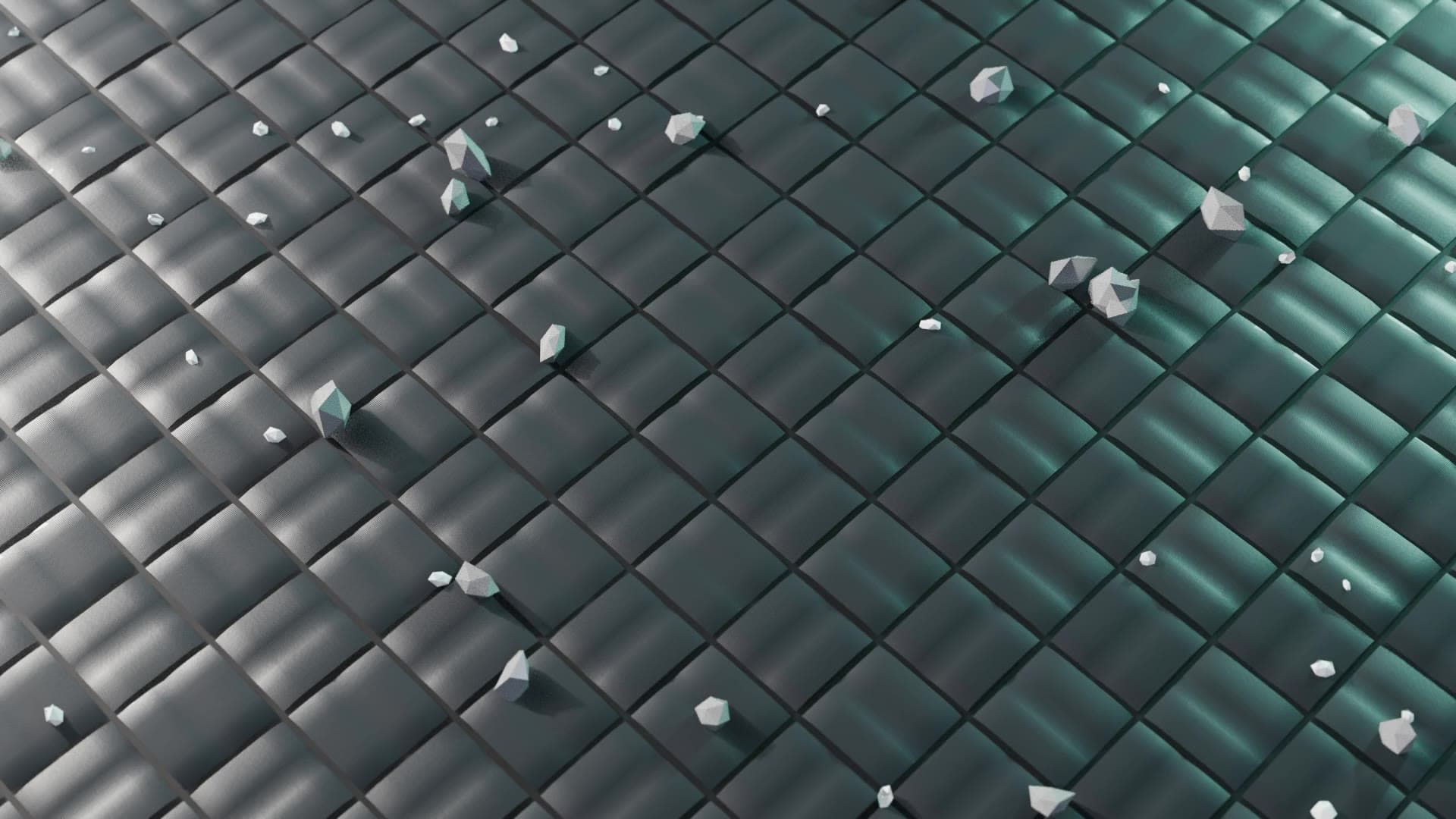
Six Zero calls its surface Diamond Tough. When you take a Coral Pro out of the box and tilt it in the light, you see a little glistening across the face. Those are commercial diamond particles embedded into the peel ply. The result feels very sandy. Even at four months, my paddle still feels like I could sand down a rocking chair with it.
Under magnification the face shows two kinds of diamond: tiny white specks, which are the small particles, and big chunky crystals, which are the large diamonds. Keep that split in mind. It matters for the results.
A bit of background on why we care so much about this: our videographer, Angela, filed a provisional patent application in April 2023 for diamond-infused paddle faces. That was more than two years before diamond paddles hit the market. We have been thinking about how to test this kind of surface for a long time.
Under the microscope: new vs. 4 months old
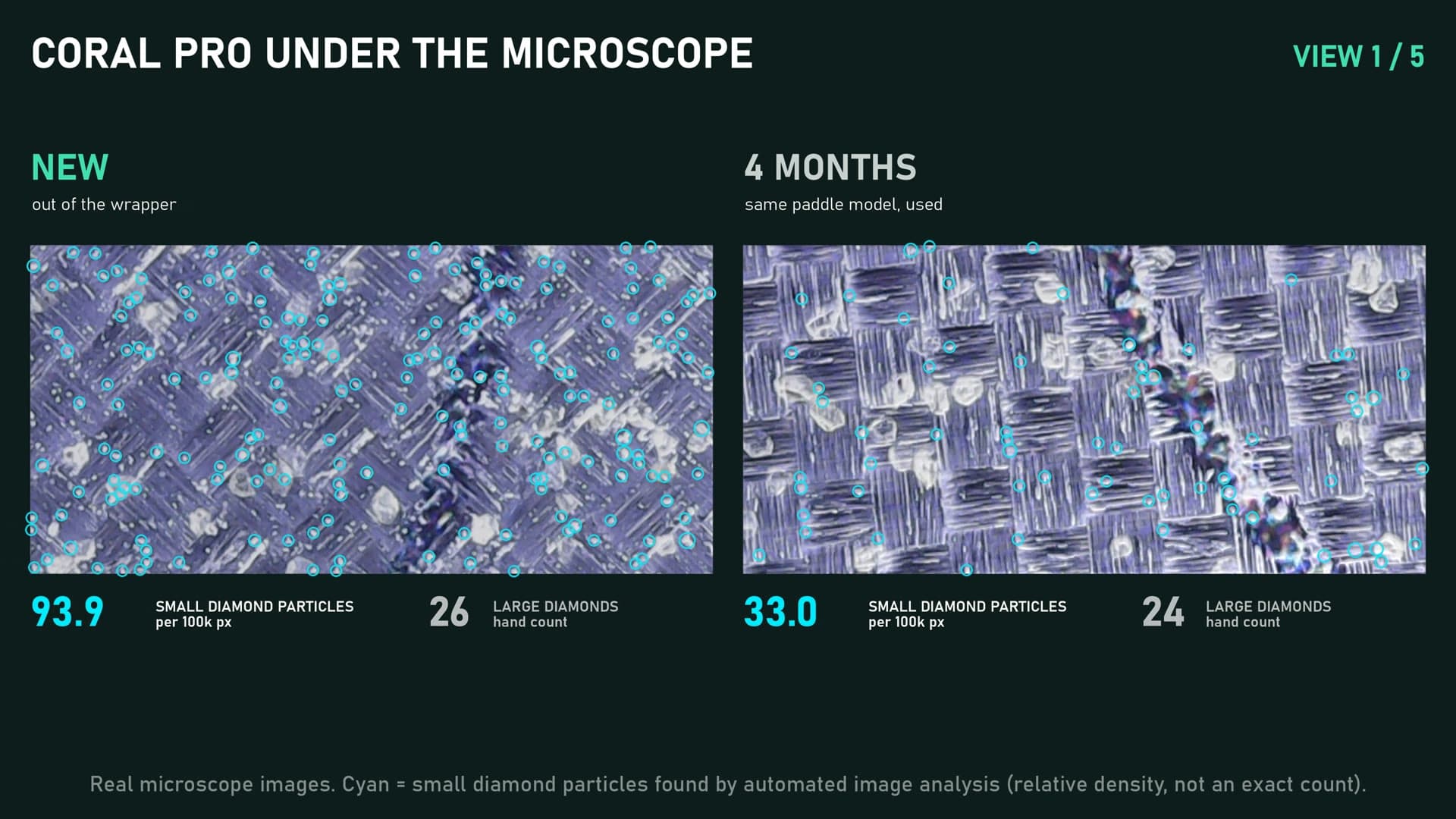
We put both faces under our microscope. The brand-new Coral Pro came straight out of the wrapper and had never been hit. The used one is the paddle I have played with for four months.
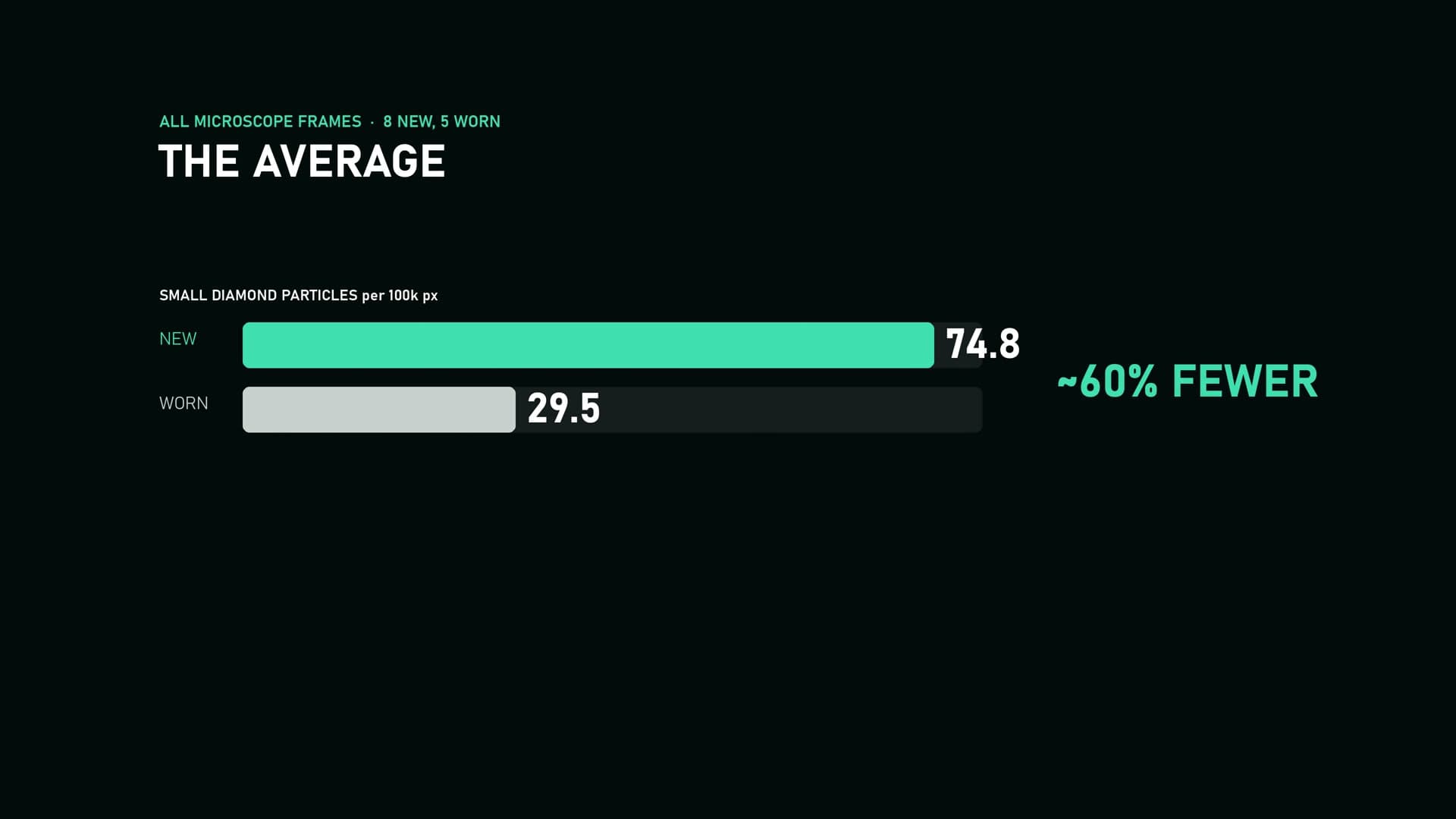
We captured 8 frames from the new face and 5 from the used face. Angela hand-counted the large diamonds in every frame, and we used automated image analysis to measure the density of small diamond particles. The small-particle number is a relative density, not an exact count, but it is measured the same way on every frame, so it works for comparing the two paddles.
- Small diamond particles: the new face averaged 74.8 per 100,000 pixels. The used face averaged 29.5. That is about 60% fewer, and the difference was statistically significant.
- Large diamonds: the new face averaged 19.6 per frame and the used face averaged 20.8. Statistically, no difference.
In plain terms, four months of play wore off most of the tiny specks and left the big crystals right where they were.
The spin test
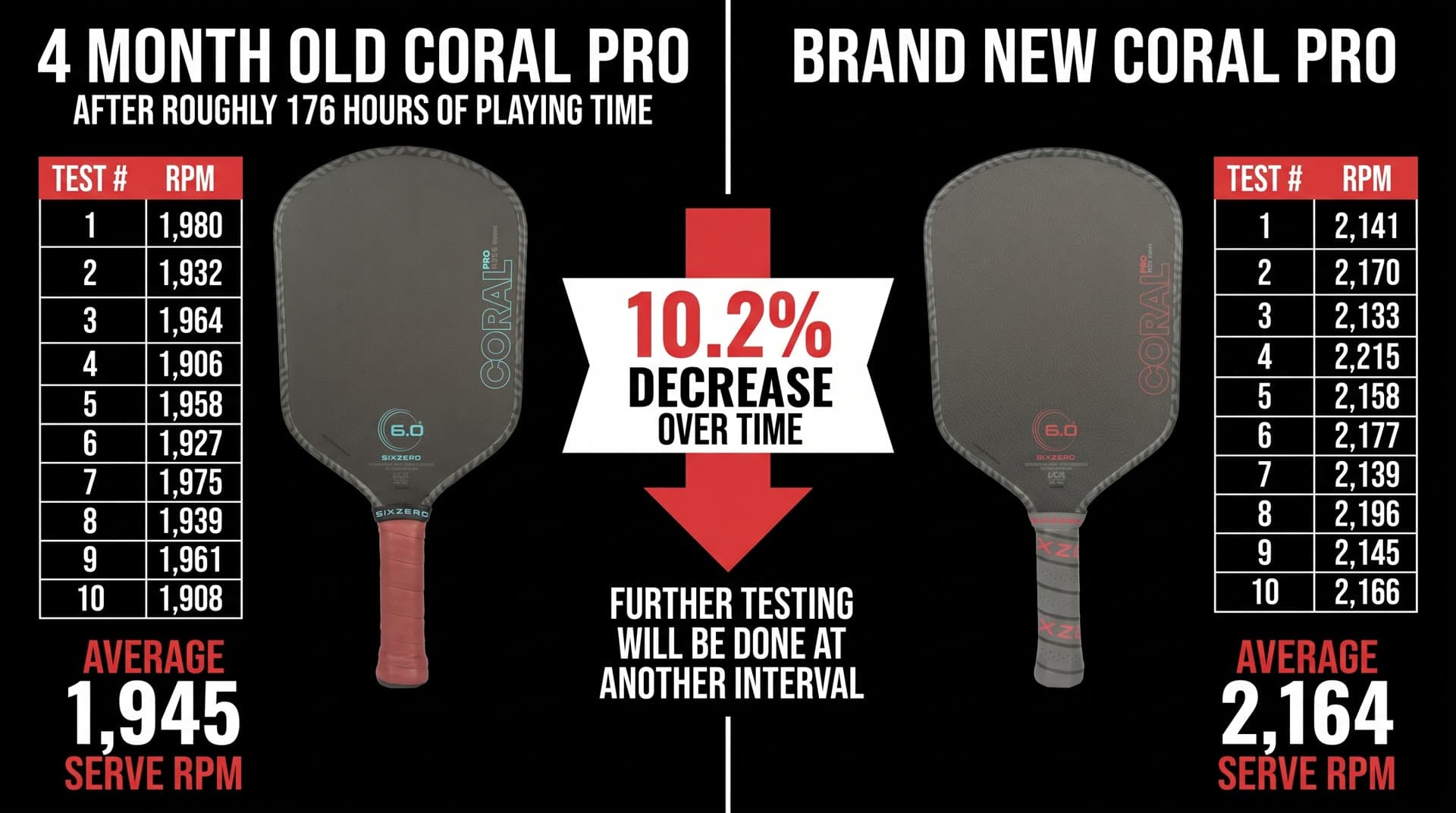
Next we took both paddles to the court and served into our high-speed spin camera, which captures at 240 frames per second. I hit 10 serves with the 4-month-old paddle, then 10 with the brand-new one, and we read the RPM off every serve.
- 4-month-old Coral Pro: 1,945 RPM average. Serves ranged from 1,906 to 1,980.
- Brand-new Coral Pro: 2,164 RPM average. Serves ranged from 2,133 to 2,215.
That is 219 RPM less on the used paddle, a decrease of about 10%. The two ranges do not overlap, so this is a real, measurable drop and not noise from one bad serve.
What I find interesting is how that lines up with the microscope. About 60% of the small particles are gone, but spin only dropped about 10%. And when I was hitting with both paddles, I did not feel a difference. That makes me think the large diamonds are doing most of the work for spin, and they have not gone anywhere.
How Diamond Tough compares to other grit surfaces
To put our number in context, here is what other paddle reviewers have published from accelerated grit testing. These tests hit a paddle face a set number of times at high speed, then measure how much spin drops.
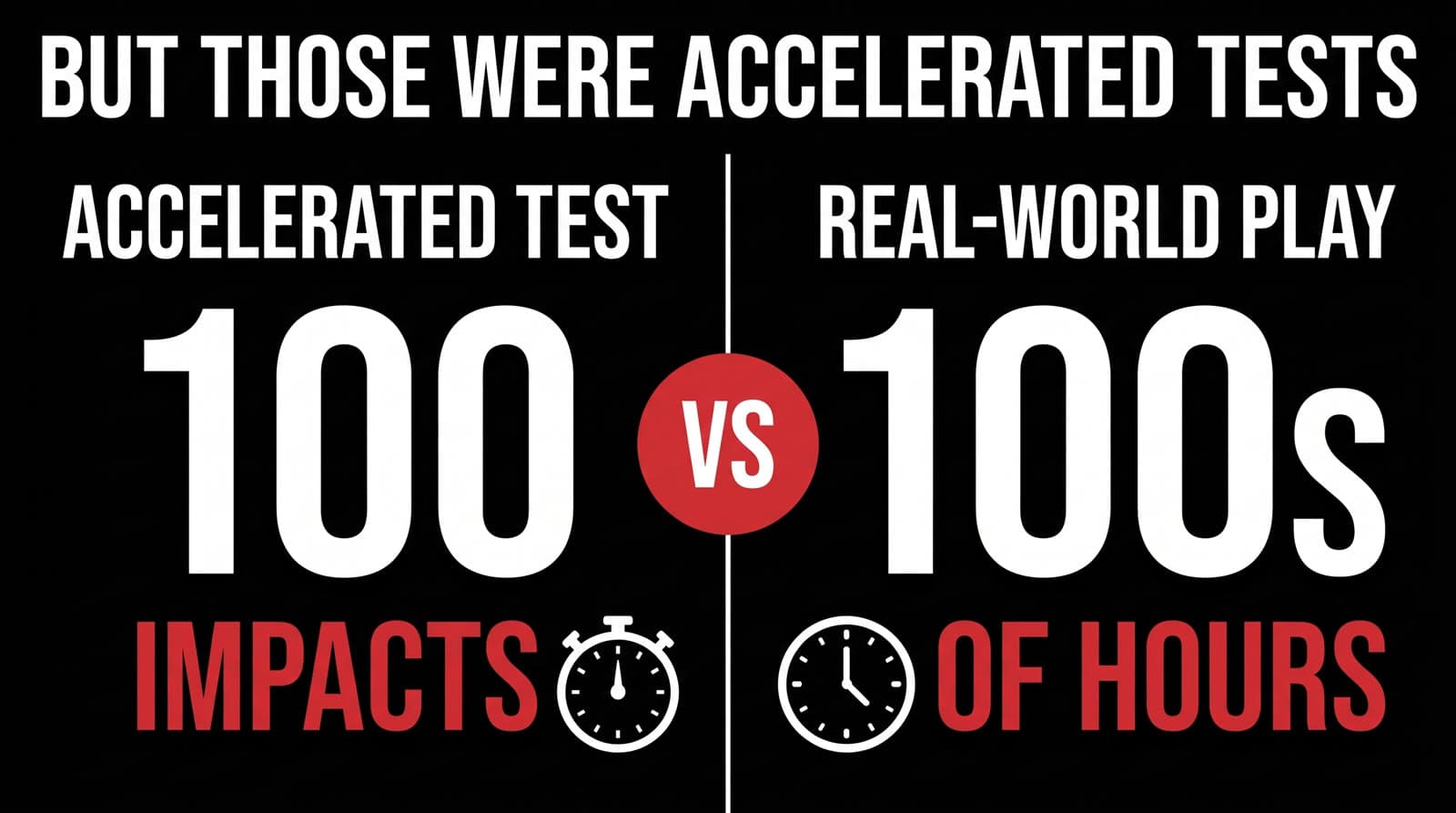
A few of the newer surfaces, including HexGrit, PermaGrit, and Six Zero’s own Diamond Tough samples, showed only 3.5% to 4.5% loss after 100 impacts. That looks better than our 10% on paper. But those were short accelerated tests. A hundred machine impacts is not the same thing as hundreds of hours of dinks, drives, resets, and the occasional scrape on the court.
Our Coral Pro lost about 10% after 176 hours of actual play. Raw carbon lost more than that in 100 impacts. That is the comparison that matters to me as a player.
What this test can and cannot tell you
I want to be straight about the limits here. This is one used paddle and one new paddle, tested by one player, at one point in time. Ten serves per paddle is enough to show a clear difference, but it is not a lab study.
What it does show is real-world wear on a paddle that has been played hard for four months, measured two different ways. Both measurements point the same direction: the small diamond particles wear off, the large ones stay, and spin drops a modest amount. We are going to keep testing this paddle and report back at the next interval.
Get the Six Zero Coral Pro
Our affiliate link applies an extra 10% off automatically. Price, stock, and discount terms can change, so confirm them at checkout.
Check Price on the Coral ProShould you buy the Coral Pro?
The spin is off the charts. It is a really good spin paddle, it has great touch, and the power is very adequate. It does not have the power of the Black Opal, but a lot of people do not want the power the Opal has. The Coral Pro gives you solid power with top-tier spin, and based on this test, it is going to last.
If you are looking at the Six Zero line, this is the one I would recommend for just about any player out there.
The bigger point is this. A lot of companies will tell you, “Well, you have used it for two or three months, of course you are losing spin.” I am not seeing that here. If you are going to spend the money on a good paddle, you want a product that holds up, and the Coral Pro has held up.
For the full breakdown of control, power, sweet spot, and feel, read my original Six Zero Coral Pro review.
Your turn
Here is the question I keep coming back to: which matters more for spin, the small diamond particles or the large ones? Our data points toward the large diamonds, but I want to hear what you think. Leave a comment on the YouTube video and let us know.
Save on the Coral Pro
Use our affiliate link for an extra 10% off, applied automatically. This may earn us a commission at no extra cost to you.
Get the Coral Pro Discount