DUPR Algorithm Change 2026: The New 0.5 Rule Explained
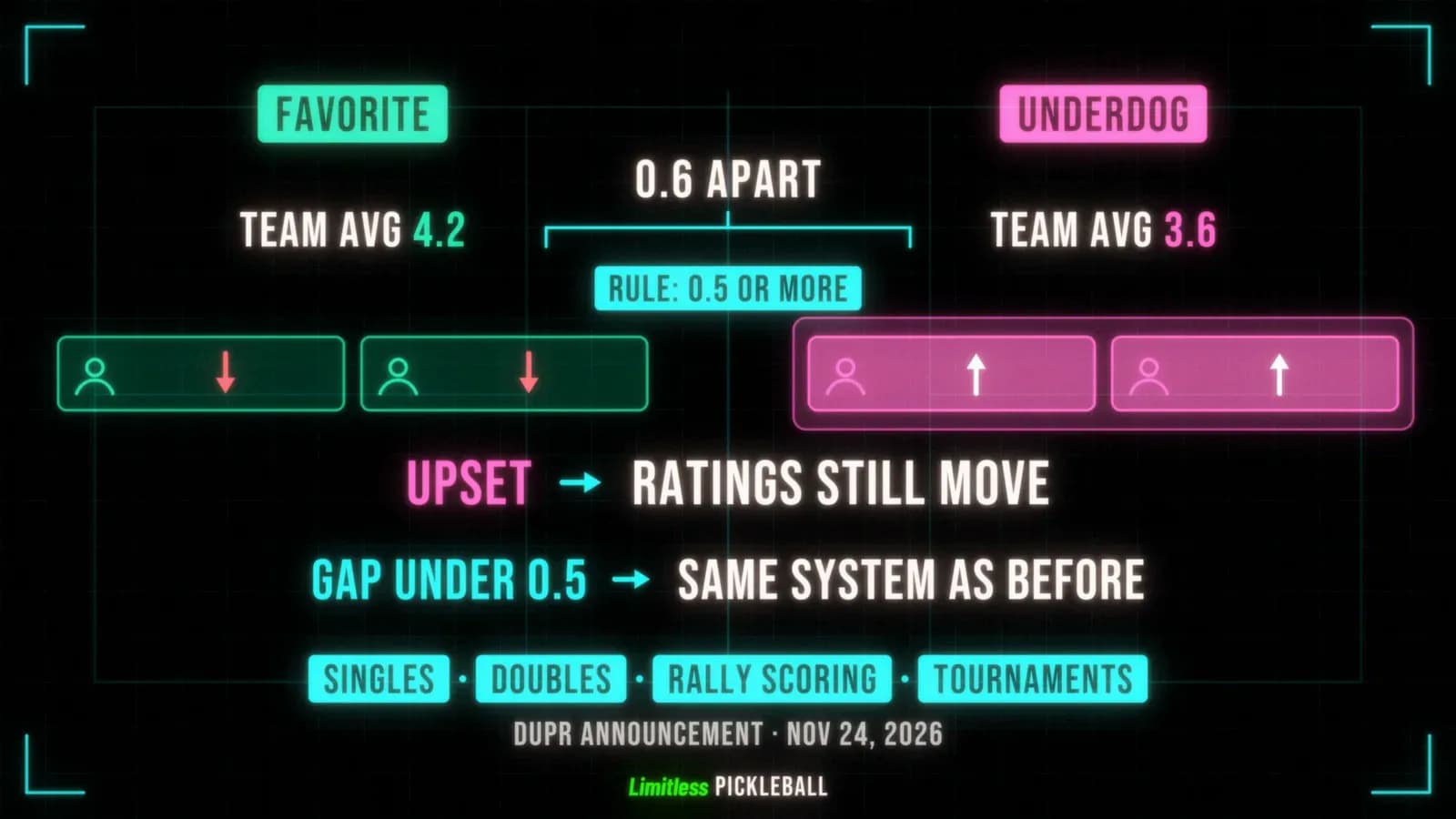
DUPR changed its rating algorithm on November 4, 2026. Now, when one side is rated 0.5 or more higher than the other (team averages in doubles) and the higher-rated side wins, nobody's rating moves, whether the score is 11-0 or 11-9. Upsets still move ratings, and when the gap is under 0.5, ratings move the same way they did before.
Here's why that matters.
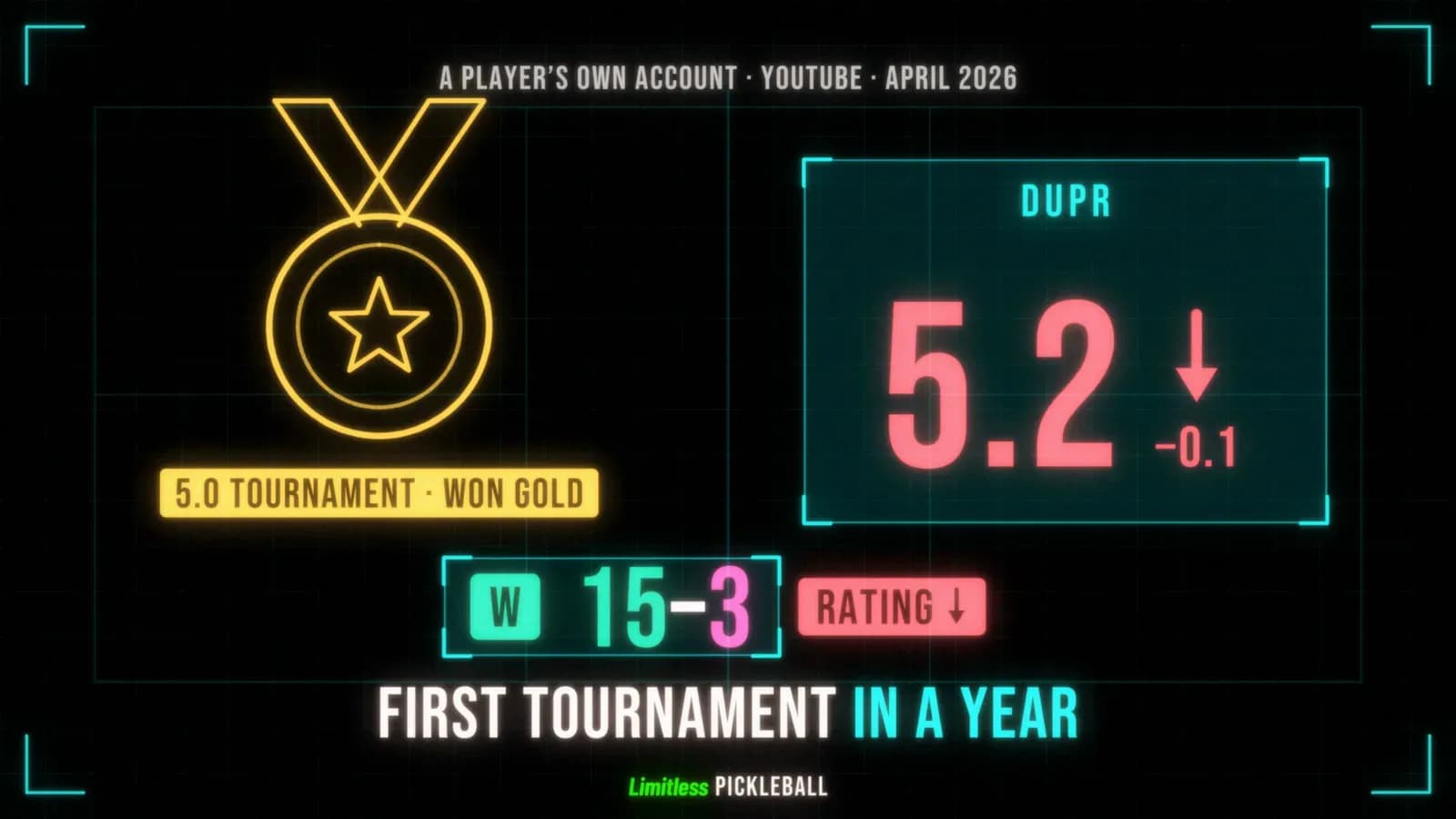
In April 2026, a player posted his own account on YouTube of a 5.0 tournament. He came in at 5.3. He won the whole thing... took gold. And his DUPR dropped to 5.2.
He beat a 4.0 team 15-3, and his rating still went down. A 15-0 win moved him up about a tenth. Then came the part that stuck with me: "This is the first tournament that I've played in in a year because I knew if I played, my DUPR would go down regardless of the outcome."
How we sourced this: The rule and DUPR quotes come from DUPR's own blog posts. Player quotes come from public r/Pickleball threads, shown without usernames. DUPR's formula isn't public, so score examples are simplified. The opinion near the end is mine.
Quick answer: DUPR's new 0.5 rule
According to DUPR, the rule covers singles and doubles, traditional and rally scoring, and both tournament and self-posted matches.
How to find the gap: In doubles, add both partners' DUPRs and divide by 2, then compare the team averages. In singles, it's your rating against your opponent's.
Why did my DUPR go down after I won?
It wasn't a glitch. It was the math.
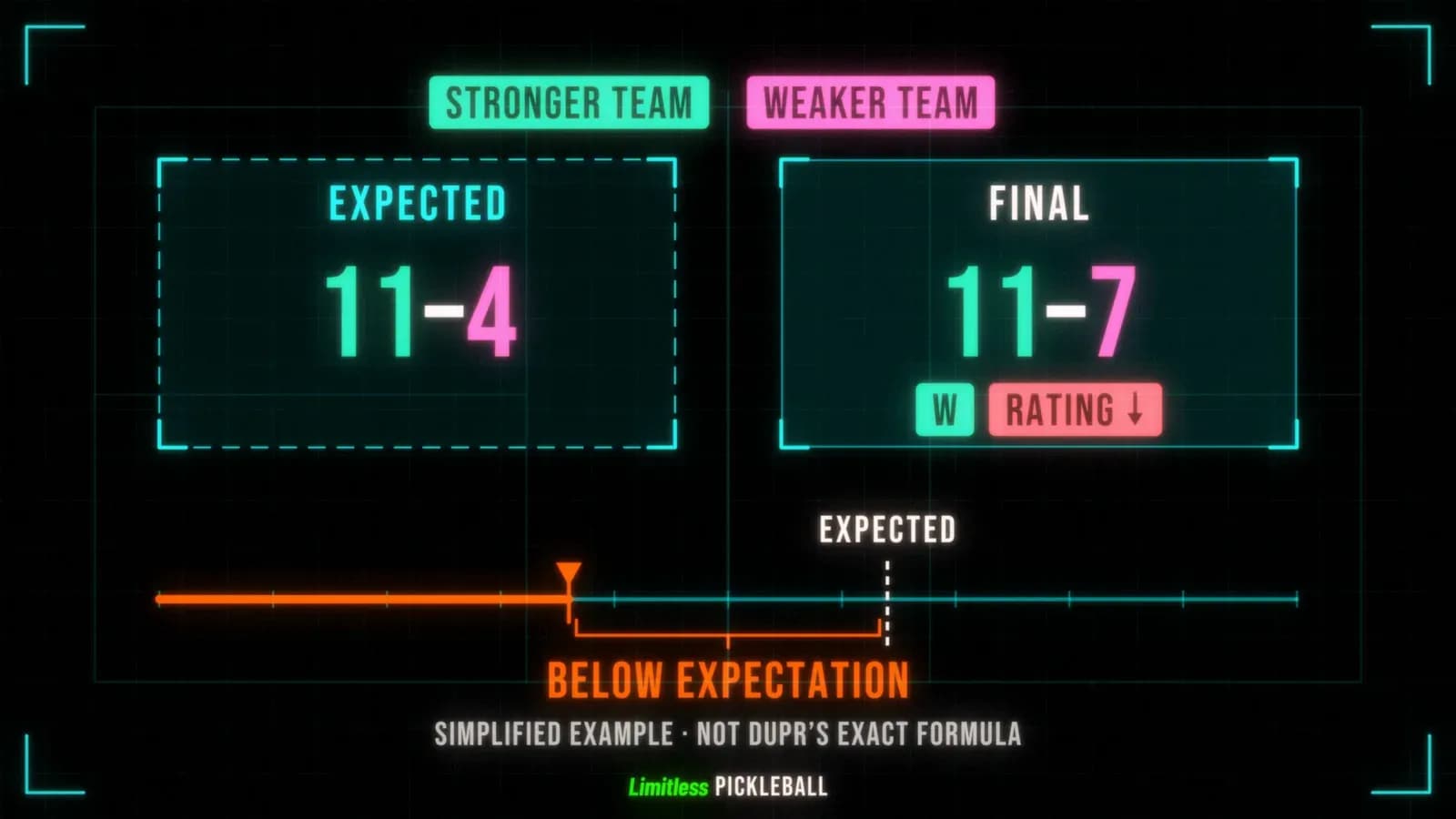
DUPR doesn't only look at who won. It compares the score with the score it expected. Here's a simplified example (not DUPR's formula, which isn't public). You're the much stronger team, expected to win 11-4. You win 11-7. You got the W... but in the algorithm's eyes, you underperformed. So your rating drops anyway.
That's still how it works when the gap is under 0.5. In DUPR's words, "your rating still moves based on how you perform against expectation. Win by fewer points than expected, and your rating can dip."
On paper, that makes sense. A rating is supposed to measure how well you play, not hand out medals. DUPR said as much in its October 30, 2025 post: "At DUPR, our priority is the accuracy and integrity of the rating, not simply rewarding players or keeping everyone happy after every match."
The problem was what it did to real players.
Higher-rated players stopped showing up
I've seen this firsthand. Higher-rated players I know just stopped signing up for tournaments. Not because they got worse. Because every match against a lower-rated team was a chance to lose rating.
And it wasn't only around here. On r/Pickleball:
- A club member, about DUPR sessions: "My club has these too and they never fill. No one wants to play random DUPR matches with random partners."
- One April 2026 thread was titled "4.6 Doesn't Want To Play Lower Rated Team."
- A self-described 4.5 player put it best back in October 2025: "You have everything to lose and nothing to gain."
DUPR heard it too. Its October 30, 2025 post listed the concerns players had raised:
"Recently, some players have raised concerns about the latest algorithm update, particularly: 1. Rating dropping after a win. 2. Higher-rated players hesitating to enter tournaments for fear of their DUPR dropping. 3. A perceived decline in tournament participation."
But it also pushed back: "We've heard concerns that tournaments aren't filling up or that registration has dropped since the update. However, the data tells a different story." It cited match volume rising from about 297,000 a month in January 2025 to about 430,000, and added: "Many of the vocal players expressing hesitation about competing are often more focused on protecting their rating than they are concerned with its accuracy."
Think about that. A rating system built to measure the best players was keeping some of them home.
What changed in DUPR's November 2026 update
DUPR's post "Important algorithm update that protects your wins," dated November 24, 2026, lays out the new rule:
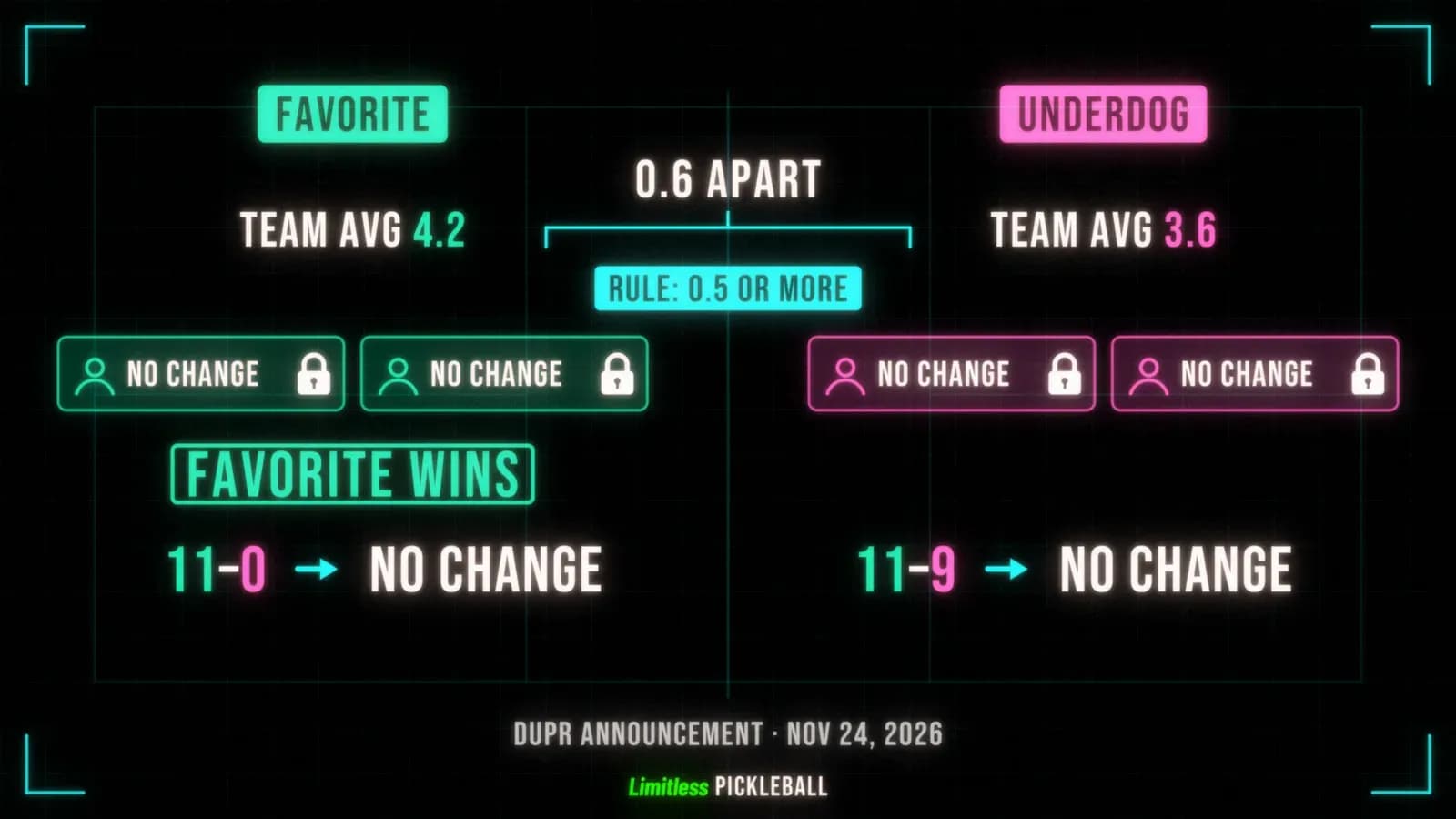
"When the AVERAGE rating for each doubles team is 0.5 or greater, and the higher rated team wins, all four players will remain unchanged, regardless of the score."
DUPR's example is a 4.2 team average against 3.6, and the post puts it plainly: "Win 11-0 or win 11-9, and your rating stays exactly where it was."
And DUPR's reason this time? "Many players told us they were hesitant to play or record matches because they worried a win could lower their DUPR. Clubs and organizers heard the same thing from their members."
A year earlier, DUPR pushed back on that worry. Now it's the reason for the change.
Live November 4, explained November 24
DUPR says "The DUPR algorithm update went live on November 4, 2026." The post explaining it came 20 days later, and players noticed first. A November 19 r/Pickleball thread titled "DUPR's new but unannounced algorithm change" showed a November 14 win that moved a rating by .000 (4.346 before and after).
Worked examples: how the 0.5 rule plays out
These came straight from questions in the comments.
What does a 0.5 gap mean?
In doubles, it's team average against team average:
- Team A: 4.4 + 4.0 = 8.4, divided by 2 = 4.2
- Team B: 3.8 + 3.4 = 7.2, divided by 2 = 3.6
- Gap: 4.2 minus 3.6 = 0.6, so the rule applies
In singles, it's your rating against your opponent's. DUPR's wording is "0.5 or greater," so a gap of exactly 0.5 counts.
The favorite (4.2) wins
All four ratings stay exactly where they were, 11-0 or 11-9. DUPR: "all four players will remain unchanged, regardless of the score."
The underdog (3.6) wins
The normal math applies. "If the lower-rated team pulls off the win, the algorithm still rewards them," DUPR says. The favorites who lost take whatever drop the normal math gives them. Exact amounts aren't public.
The underdog loses 11-9
Nothing moves. Not the winners, not the losers. At 0.5 or more, there's no credit for almost winning.
The gap is under 0.5 (say, 4.2 vs 3.8)
That's a 0.4 gap, so the old math applies. The winner can still dip if they win by less than expected.
The half-point cliff: 0.49 vs 0.50
Here's the number people are fighting about.
Say the gap is 0.49. You're the underdog, and you lose a close one, 11-9. Under the old math, DUPR can still give you credit for playing them tough. Now make the gap 0.50. Same match. Same score. It counts for nothing.
One hundredth of a point... and your best game of the night disappears.
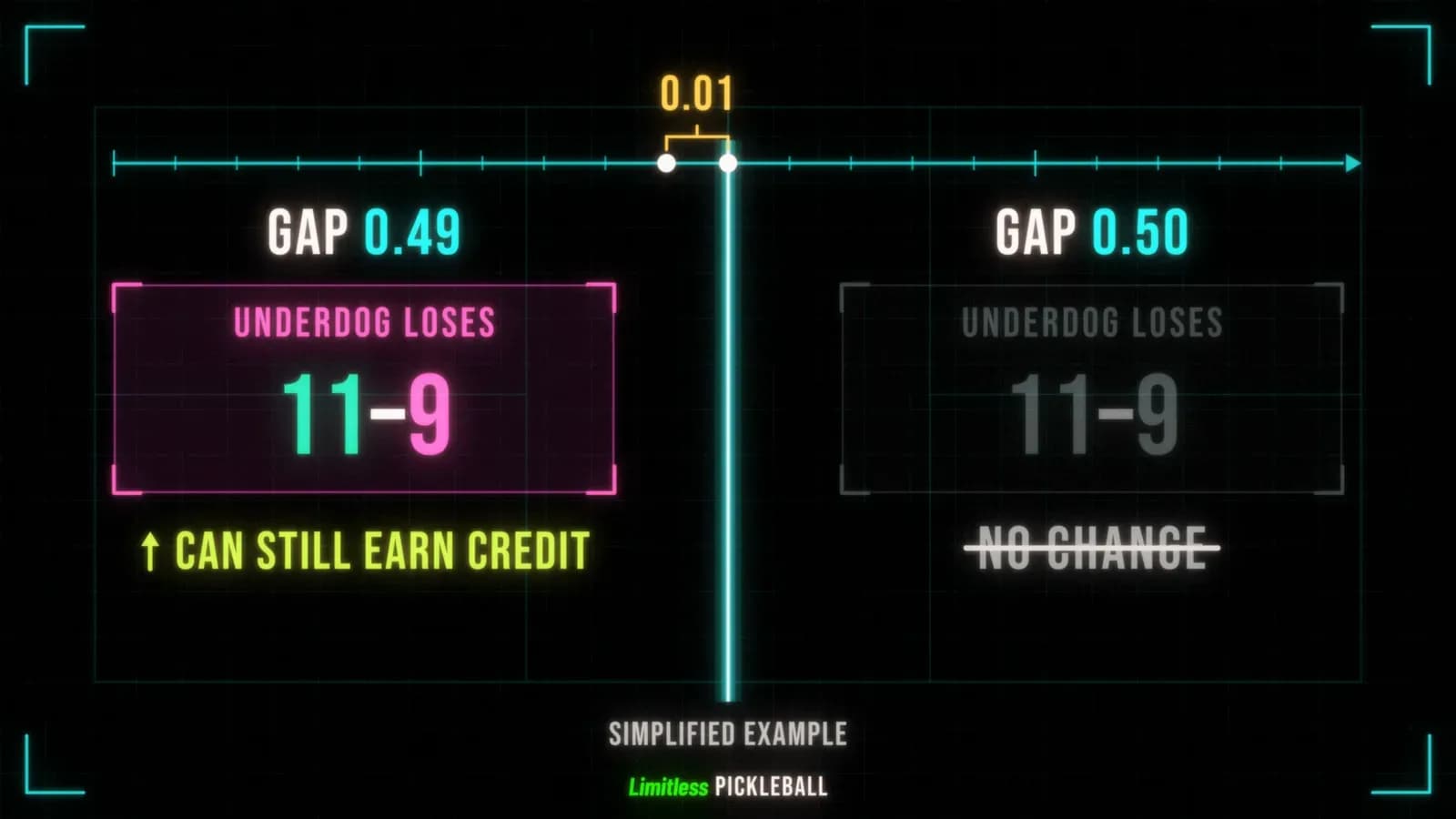
One r/Pickleball post from November 24 put it like this:
"...why DUPR thinks .51 the underdog deserves no credit for almost winning but .49 deserves a ton of credit to me is fundamentally flawed."
The same post makes a point about the favorites: "So they still have a lot to lose but nothing to gain." That matches the rule. At 0.5 or more, the favorite's best case is no change, and if they lose, the normal math still drops them. And a team playing up by 0.5 or more can't lose rating at all.
Sound familiar? It's the same complaint as before... just smaller.
The most common view in the Reddit threads we read (not a poll): right idea, wrong threshold. The top reaction in one thread: "Partial improvement at best. The gap should be 0.75, not 0.5." Others like it: "Kinda makes sense. A 3.5 that loses 100 times to a 4.5 doesnt make them less than of a 3.5"
My take: a GOOD change that needs one fix
So, good change or bad change? It's a GOOD change. A winner should never lose rating for winning. For the player who won gold and dropped, this fixes it. Win the match, keep your rating. That's what most players were asking for.
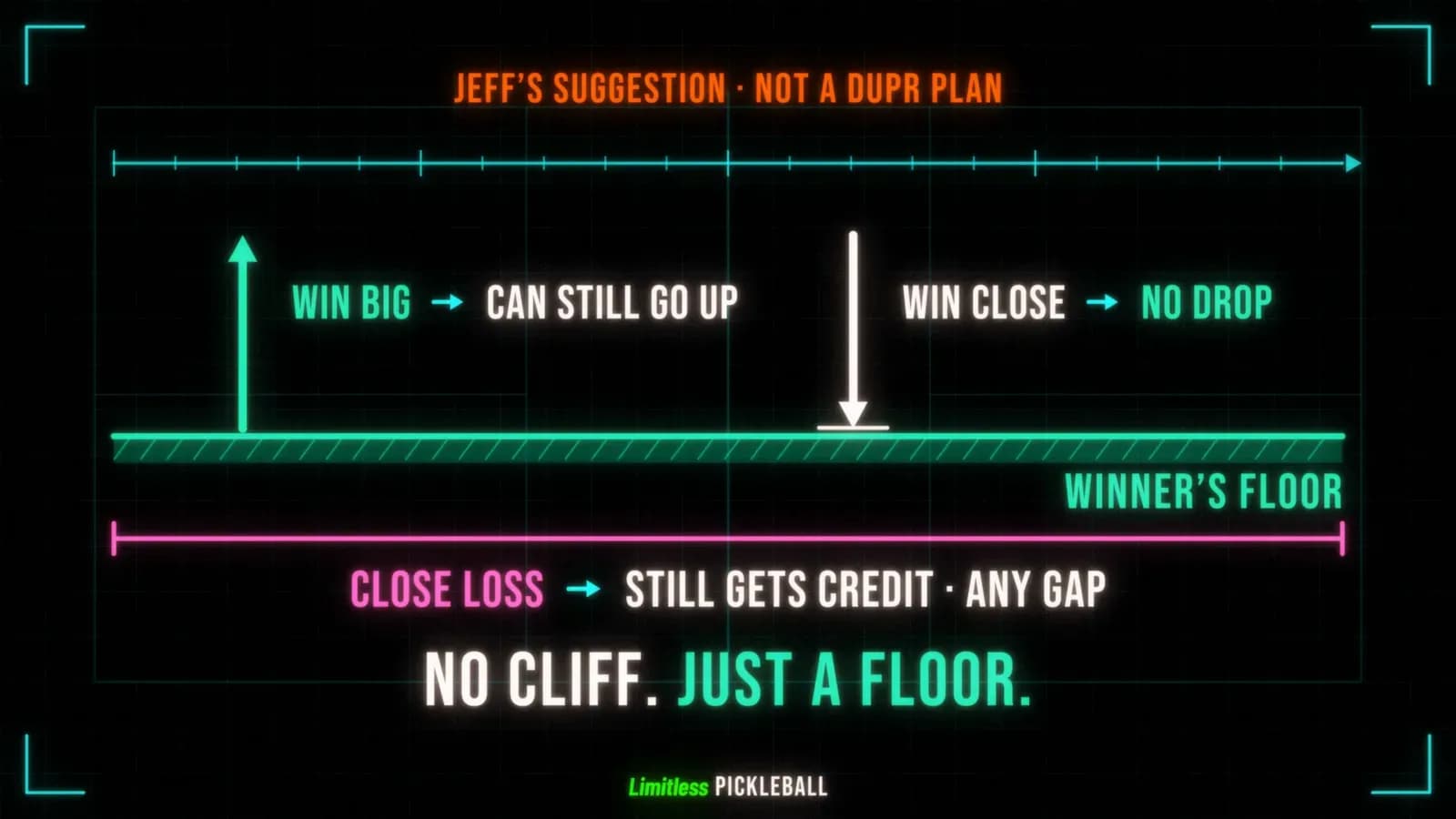
But a hard cutoff is a patch.
Here's what I'd do. Keep the old math and put a floor under the winner:
- Win big: you can still go up.
- Win close: you just don't go down.
- Underdog plays them tough: still gets credit, at any gap.
No cliff. Just a floor.
To be clear, that's my suggestion, not a DUPR plan.
Bottom line? DUPR fixed the rule that was keeping people home. Now it needs to fix the cliff.
Should a winner EVER lose rating?
Watch the full breakdown, then tell me in the comments: YES or NO?
And if DUPR kept you out of tournaments, tell me whether this brings you back.
Watch: DUPR's new 0.5 rule, explained →Frequently asked questions
What is the DUPR 0.5 rule?
When two sides are 0.5 or more apart and the higher-rated side wins, no one's rating changes, whatever the score. In doubles, average each team: 4.4 and 4.0 make 4.2, and 3.8 and 3.4 make 3.6, a 0.6 gap. DUPR says it covers singles, doubles, rally and traditional scoring, and tournament and self-posted matches.
When did DUPR change its algorithm?
DUPR says the update went live on November 4, 2026. It explained the change on November 24, 2026, after players had already spotted wins showing zero change.
Why did my DUPR go down after I won?
DUPR moves ratings based on how you perform against expectation, so winning by fewer points than expected can drop you. Since the November 4 update, that no longer happens when your side is the favorite by 0.5 or more. It still can when the gap is smaller.
Does the underdog get credit for a close loss?
Not at a gap of 0.5 or more. All four ratings stay the same. Under 0.5, a close loss can still earn credit, depending on the expected score. If the underdog wins, ratings still move; DUPR says the algorithm "still rewards them."
Sources and methodology
- Our video on DUPR's algorithm change, Limitless Pickleball.
- DUPR, "Important algorithm update that protects your wins", November 24, 2026.
- DUPR, October 30, 2025 ratings post, now titled "Request a Review of Your Rating."
- Public r/Pickleball threads: "Advanced players, do you even play tournaments anymore due to the new DUPR rules" (Oct 2, 2025); "How to increase DUPR participation at new club" (comment, Dec 12, 2025); "4.6 Doesn't Want To Play Lower Rated Team" (Apr 14, 2026, title only); "DUPR's new but unannounced algorithm change" (Nov 19, 2026); "DUPR Update" (Nov 24, 2026).
- A player's own YouTube account of his 5.0 tournament (April 11, 2026). We don't name or link him.
- Method: Checked November 24, 2026. Quotes are verbatim, typos included, with no usernames. Score examples are simplified; DUPR's formula and exact rating changes aren't public.